Why Uncertainty Is Your Biggest Opportunity in Australian Property Right Now
This month’s Federal Budget delivered the biggest shake-up to property investment tax in a generation. And yet the data from every major downturn since 1990 tells the same story: the investors who acted when others hesitated captured the greatest long-term gains. Here’s what the numbers and the fine print actually say.
What Actually Changed on Budget Night
Let’s deal with the headlines first.
From 1 July 2027, two significant changes take effect for investors in established residential property:
Negative gearing is ring-fenced.
If you purchased an established investment property after 7:30pm on 12 May 2026, rental losses can no longer be offset against your salary income. Losses carry forward and can be applied against future residential property income, however the annual tax refund most investors rely on is gone for new purchases.
The 50% CGT discount is replaced.
A new system introduces cost base indexation plus a 30% minimum capital gains tax rate from 1 July 2027. You’ll only be taxed on real gains above inflation, but a minimum 30% rate applies. For moderate long-term growth, outcomes are broadly similar to today. For high-growth assets, expect a higher tax bill at sale.
What hasn’t changed:
• New residential property: full negative gearing retained, plus your choice of CGT method at sale
• Existing investors: if you bought before Budget night, your arrangements are fully grandfathered for as long as you hold
• Super and SMSFs: completely unaffected
And critically – none of this is law yet. It still needs to pass a Senate that Labor doesn’t control. Don’t make rushed decisions based on headlines alone.
The Part the Headlines Won’t Tell You
Tax incentives have always been a bonus, not an investment strategy. The quality of the asset, the strength of the location, and the underlying demand are what drive long-term wealth creation. That’s been true through every policy cycle, every rate cycle, and every crisis of the past 35 years.
The investors who will feel these changes most are those who were relying on tax losses to make a borderline deal work. If the numbers only stacked up because of a government subsidy, they were never great numbers to begin with.
Strong assets in the right locations will keep performing. They always have.
Three Downturns. Three Recoveries. One Clear Pattern.
There is a certain kind of investor who always seems to get the timing right. They bought after the 1990 recession, held through the dot-com uncertainty, added to their portfolio during the GFC when headlines were screaming ‘crash’, and picked up another asset during COVID lockdowns when the country was at a standstill.
They weren’t lucky. They simply understood something that media cycles consistently obscure: Australian property has recovered from every major downturn in modern history and the investors who entered during periods of maximum fear captured maximum reward.
| 1990-91 Recession | 2008 GFC | 2020 COVID | |
|---|---|---|---|
| Peak-to-trough dip | ~5% | ~6.4% | ~2-3% |
| Months to full recovery | ~24-36 | ~12 | ~3 |
| 5-year gains post-trough | +28% | ~+100% | +28.6% by end 2022 |
The 1990–91 Recession: The RBA cash rate peaked at 17.5% — nearly four times today’s level. Unemployment hit 11.2%. And yet national property prices dipped only ~5% and recovered within two to three years. The worst economic recession in a generation produced a property correction that barely registers on a long-term chart.
The 2008 GFC: Global credit markets froze. Analysts forecast Australian property falls of 20–40%. What actually happened? A ~6.4% dip, full recovery within 12 months, and a national median that approximately doubled over the following five years. Every investor who waited for certainty missed the single biggest five-year run in Australian property history.
COVID-19: GDP fell 7% in a single quarter. Predictions of a 20–30% crash filled the financial pages. The actual dip was 2–3%, lasting approximately three months. National property then grew +22.1% in 2021 alone, a single-year record.
The pattern is consistent and unambiguous. Every major shock produced a dip of 2–7%. Every dip was followed by full recovery within 3–30 months. And every recovery was followed by significant multi-year gains.
Why Today’s Market Is Structurally Stronger Than Any Previous Downturn
Previous downturns occurred against a backdrop of adequate housing supply. Today is different.
Australia will be 262,000 homes short of its 2029 National Housing Accord target, with only 177,000 homes built in 2024 against a need of 223,000+. This is not a short-term disruption, it is a chronic, worsening structural deficit.
The national rental vacancy rate sits at 1.3% – less than half the pre-COVID decade average of 3.3%. Rental listings are 17% below five-year averages. National rents rose 5.2% in 2025. The shortage is not a forecast. It is here now.
Today’s unemployment rate of ~4% is near full employment, far better than 11.2% in 1990 or 7.5% at the COVID peak. In most of the factors that matter for long-term property performance, today’s market is considerably stronger than at the start of any previous recovery.
Addressing the Fears Keeping Investors on the Sideline
On the tax changes: waiting is not the safe option. If the proposed changes don’t pass the Senate, those who waited lose months of capital growth and rental yield for nothing. If they do pass, those who bought before Budget night are protected under grandfathering arrangements.
History is also instructive here. Negative gearing was abolished between 1985 and 1987. Rents spiked. Investors adapted. Prices rose. The market fully adjusted within two years. Fewer investors in established property means less rental supply, which with a vacancy rate already at 1.3%, would accelerate rent growth and ultimately push values higher.
On interest rates: every rate-rise cycle in Australian history has been followed by a rate-cut cycle. The investors who buy before rates fall capture the full benefit of the uplift in borrowing power and buyer confidence that rate cuts produce.
On geopolitical uncertainty: the Middle East conflict, like every geopolitical shock before it, generates anxiety in financial markets. It does not build or destroy houses. Australian property recovered from every crisis since 1990: the Gulf War, the Asian financial crisis, SARS, the GFC, the European debt crisis, COVID-19.
The Mathematics of Waiting
Waiting can feel safe.
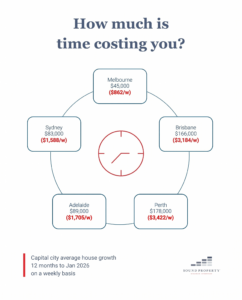
But in a rising market, waiting has a cost.
The Sound Property analysis looks at capital city average house growth over the 12 months to January 2026 and breaks it down on a weekly basis.
Of course, property investment is never just about chasing short-term growth.
However, the broader point is important.
When strong fundamentals are in place, staying on the sidelines is not always the low-risk option. It can mean giving up growth, rental income, and negotiating opportunities that may not be available once confidence returns.
The goal is not to rush. The goal is to be prepared enough to act when the right opportunity appears.
The actual opportunity cost in many of our target markets is significantly higher. Over 14 years, Sound Property clients have made an average of nearly $400,000 each, not because of tax benefits, but because of the quality of the assets they bought, at a long-term compound growth rate of 12.4% p.a. Property is a leveraged investment, and the leveraged return on deposit is considerably higher still.
The Noise Will Fade. The Shortage Won’t.
Every downturn since 1990 has eventually resolved. The Gulf War ended. The GFC became a case study in government intervention. COVID became history. In every case, the investors who acted during the fear, rather than waiting for its resolution, captured the best returns.
What is genuinely different about today’s market is not the uncertainty. It is the structural undersupply. Australia has never faced a housing shortage of this magnitude alongside record-low vacancy rates and above-inflation rent growth.
The media noise will fade. The shortage won’t. The window to buy before competition returns, and prices reflect it, is the part that won’t last.
How Sound Property Can Help
Sound Property is a specialist Buyers Agency focused exclusively on investment property. We find, analyse, negotiate, and secure assets on behalf of our clients. Without emotion, without conflict, and with a rigorous process built on 14 years of market experience across NSW, VIC, QLD and SA.
Right now we’re helping investors across four areas:
• Existing investors who want to understand their portfolio position and CGT exposure before making any decisions
• New build investors who want independent location and project analysis, not a developer’s sales pitch
• Investors looking to use their SMSF to build wealth with the benefits of leveraged returns
• Investors building a portfolio who want assets that genuinely perform, with or without tax concessions
A short conversation is often all it takes to get clarity.