
Tax Benefits Don’t Create Wealth. Capital Growth Does.
Why an established house with no negative gearing can still outperform a new, tax-advantaged townhouse over a 10-year hold, even though it feels like the harder property to own.
Ask most first-time investors whether to buy a new townhouse or an established house, and the new build usually wins the conversation before it’s even started. It comes with negative gearing, a fat depreciation schedule, and the promise of tax refunds that soften the cost of holding it. The established house comes with none of that, just a tax office that isn’t interested in helping.
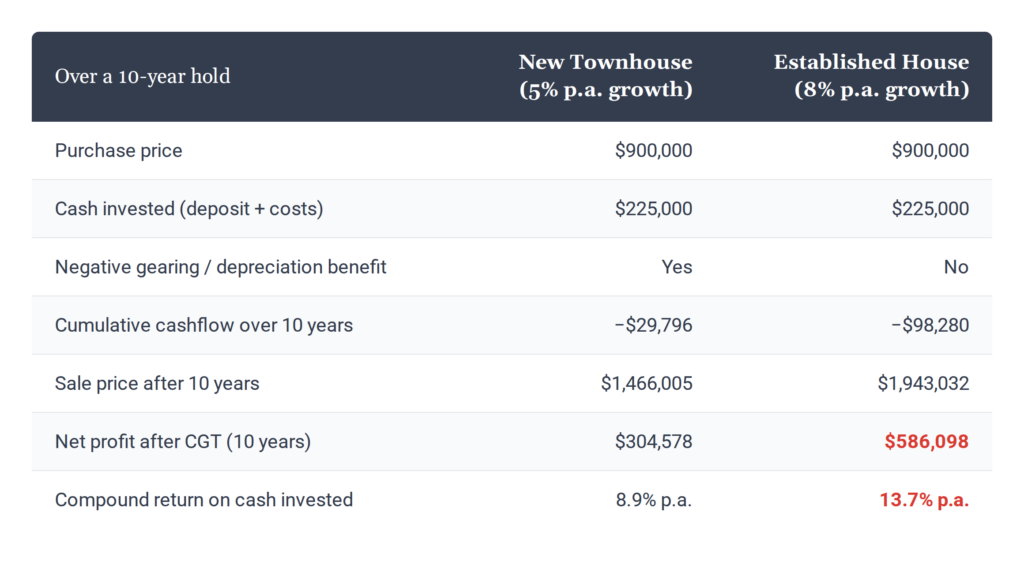
However, run the two side by side over a full 10-year hold, on the same $900,000 purchase price, and the picture flips. The established house, weaker cashflow and all, ends up close to double the profit.
Since new builds usually sit in higher-density growth corridors where developers can keep releasing new stock in response to demand, land supply stays relatively elastic and that caps the scarcity-driven price growth new-builds can achieve. Established houses, by contrast, occupy a largely fixed and often more centrally-located land supply in already-built-out suburbs, where planning constraints, heritage overlays, and limited available land mean new competing stock can’t simply be built to meet demand, so price growth leans more heavily on land scarcity, which is why the model uses 5% p.a capital growth for the new townhouse and 8% p.a for the established house.
The Comparison
We modelled a $900,000 purchase two ways: a new townhouse with a 5% p.a. capital growth assumption, negative gearing and depreciation, against an established house with an 8% p.a. capital growth assumption and no negative gearing at all. Both start with the same $225,000 in deposit and purchase costs.
Figures are illustrative projections modelled over a 10-year hold. See assumptions at the end of this article.
Why Established Wins Despite the Cashflow Pain
Both properties actually run a cash shortfall for most of the 10 years under realistic rental assumptions. The new townhouse’s shortfall is smaller and improves faster, thanks to its depreciation and negative gearing tax refunds, turning slightly positive by Year 10. The established house runs a deeper shortfall throughout, roughly $85 to $200 a week more than the new townhouse, tapering over time but never quite turning positive.
That’s the entire case for buying new: it’s easier to hold. But it isn’t the same thing as being more profitable, and conflating the two is where a lot of new-build sales pitches quietly go wrong.
The reason established pulls ahead is simple compounding. Growth of 8% instead of 5% doesn’t sound like a large gap, but it compounds on a bigger and bigger number every single year the property is held. The new townhouse’s tax benefits, meanwhile, are fixed in dollar terms and actually shrink over the decade as the depreciation schedule runs down from $19,000 in year one to $11,000 by year ten. One side of the ledger grows; the other side fades.
Put another way: a tax refund is money back on a loss. Capital growth is real, compounding wealth. They are not the same kind of return, and treating them as interchangeable is how the weaker asset ends up looking like the safer bet.
The Two CGT Methods at Play
The net profit figures above also reflect the fact that each property is taxed differently at sale. The new townhouse elects the 50% CGT discount, the standard concession for a discounted capital gain. The established house instead uses cost-base indexation, adjusting its purchase costs upward by inflation (2.78% p.a. compounding) before calculating the taxable gain.
These are the two CGT methods currently available depending on the type of residential property being sold, and the choice materially affects the after-tax result for each scenario, on top of the underlying growth difference.
What’s Changing from 1 July 2027
This comparison already assumes the negative gearing reform in the 2026–27 Federal Budget: from 1 July 2027, negative gearing on established residential property is restricted to offsetting rental or residential capital-gain income only, not general income, for properties purchased after 12 May 2026. New builds keep full negative gearing regardless.
In other words, the “immediate benefit” case for buying new isn’t just weaker on the numbers, it’s also the only version of that benefit that survives the current rules for a property bought today.
The Takeaway
A new townhouse with negative gearing feels like the lower-risk, easier-to-hold investment, and day to day, it is. However wealth isn’t built on what a property gives back at tax time. It’s built on what the asset itself is worth when you sell it. On these numbers, the established house’s extra $68,500 of cash cost over 10 years buys an extra $281,500 in net profit, a trade most investors would take if it were framed that clearly from the start.
Tax benefits don’t create wealth. Capital growth does.
Assumptions & Disclaimer
Figures are illustrative projections based on stated assumptions: 5%/8% p.a. capital growth, 4.5% starting rental yield increasing at 2.78% p.a., 30% marginal tax rate on annual cashflow, 47% top marginal rate plus Medicare levy on the capital gain in the year of sale, 50% CGT discount elected for the new build, indexed cost base for the established property. Sound Property Group Pty Ltd has made a number of assumptions when preparing this analysis; these assumptions have a material impact on the financials and should be assessed carefully before purchasing. This article contains projections and forward-looking statements involving unknown risks and uncertainties; actual results may differ materially. This is not financial product advice and does not take into account your objectives, financial situation or needs. Obtain your own financial, taxation and legal advice before making any decision.