
Every time interest rates rise, the same story starts doing the rounds: property prices have to fall.
It is a simple narrative, but it is not an accurate one.
Interest rates matter. They affect borrowing power, buyer sentiment and household budgets. But they are only one part of the property market equation. In reality, property prices are shaped by a broader mix of forces including housing supply, population growth, rental conditions, employment, credit policy and local demand. That is why rising prices can, and often do, co-exist with rising rates.
Australia has already seen this play out in recent years. Even after the Reserve Bank lifted the cash rate aggressively through 2022 and into 2023, national home values rebounded and finished 2023 higher, showing that higher rates alone were not enough to stop prices rising when other market fundamentals remained strong.
Why the market does not move on rates alone
The property market is not driven by one lever.
Yes, higher rates reduce how much some buyers can borrow. But they do not automatically erase demand. In many markets, demand is being supported by strong population growth, limited new housing supply and an extremely tight rental market. When there are more people competing for fewer homes, prices can remain resilient even in a high-rate environment.
This is the point many buyers miss. They sit back waiting for rates to fall, assuming that cheaper finance will create a better buying window. But by the time rate cuts arrive and confidence returns, competition often lifts quickly as more buyers re-enter the market at once. In other words, the best opportunity is often during uncertainty, not after it disappears.
Rising rates and rising prices can exist at the same time
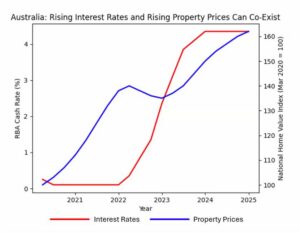
This is not just theory. It is what the market has already shown us.
The RBA’s cash rate rose sharply from the historic lows of the pandemic era, yet national property values recovered through 2023. That happened because the rate backdrop was only one part of the story. Tight listings, strong migration, low vacancy and constrained construction helped outweigh the drag from higher borrowing costs.
For investors, that is a crucial lesson.
Waiting for a perfect rate environment can mean missing the period when assets are still relatively well-priced, competition is thinner and sellers are more negotiable. Once sentiment turns, the market can move faster than many expect.
Supply remains the biggest pressure point
One of the strongest supports for property prices right now is the lack of housing supply.
Australia is still dealing with a structural undersupply of dwellings. Treasury notes the role of the National Housing Supply and Affordability Council in addressing housing supply challenges, and the latest ABS building activity data shows that while dwelling commencements lifted in the September 2025 quarter, completions remain well below the pace required to materially ease the shortage. The next ABS building activity release for the December 2025 quarter is due on 8 April 2026, which means the latest confirmed official picture still points to a market that has not built enough homes.
That matters because supply shortages do not disappear just because rates are high.
When new stock is slow to come online, existing homes become more valuable, particularly in well-located suburbs with strong owner-occupier appeal and limited turnover. This is one reason broad predictions of price falls often miss the mark. The national market may slow, but quality assets in supply-constrained locations can continue to perform.
Tight vacancy rates are keeping pressure on the market
The rental market is sending the same message.
SQM Research reported that Australia’s national residential vacancy rate fell to 1.2% in January 2026, down from 1.4% in December 2025. Total residential vacancies dropped to 37,630 dwellings, pointing to very tight rental conditions nationally.
A vacancy rate this low has two important implications.
First, it reflects intense competition for rental housing, which supports ongoing rental growth in many parts of the country. Second, it reinforces the underlying imbalance between supply and demand. When renters are struggling to find available homes, it is a sign the broader housing market remains undersupplied.
For investors, this can improve the appeal of well-bought assets. Strong rental demand can help support yields and reduce vacancy risk, even while interest rates remain relatively elevated.
This is where opportunity appears
When rates rise, confidence tends to fall first.
Some buyers pause. Others decide to “wait and see”. Media coverage becomes more cautious. Transaction volumes can soften. But that does not necessarily mean fundamentals have weakened. Often, it simply means sentiment has.
That disconnect can create opportunity.
Savvy investors understand that markets are usually won by acting before the broader crowd feels comfortable again. When uncertainty is high, there is often less competition, more room to negotiate and a better chance to buy quality assets before momentum returns.
Then, when rates eventually stabilise or fall, confidence comes back quickly. More buyers re-enter. Competition lifts. Prices can accelerate faster than expected. By that point, the easy part of the opportunity has usually passed.
The real question investors should be asking
Instead of asking only, “What are interest rates doing?”, investors should be asking better questions:
- Is supply tight in this market?
- Is rental demand strong?
- Are vacancy rates low?
- Is population growth adding pressure?
- Is this a quality asset in a location with lasting owner-occupier appeal?
These are the questions that matter because they get to the heart of what drives long-term performance.
Rates influence the market, but they do not control it on their own.
Final thoughts
Interest rates are not the only thing driving the property market — and they are certainly not the only thing driving prices.
Australia’s recent experience is proof that rising rates and rising property prices can co-exist. When supply is constrained, vacancies are tight and demand remains firm, prices can stay resilient and even continue climbing.
Right now, that is exactly why there is still an opportunity for savvy investors.
The buyers who tend to do best are not the ones waiting for the headlines to become optimistic again. They are the ones who understand the broader market forces at play, act while confidence is patchy, and secure quality property before the next wave of competition arrives.